

Tutoyer ou vouvoyer — to say tu or vous — is a question almost every newcomer to a French workplace faces in their first days. It’s not just a grammar choice; it’s a marker of formality, respect, and workplace dynamics. The decision can arise not only at the start of a new job, but also every time you interact with a new manager, client, or colleague in a higher position.
And while vous has long been the safe, polite default, its dominance is fading in many professional settings. A LinkedIn survey of 3,314 respondents revealed that only 6% always use vous with professional contacts, while 41% adjust based on hierarchy. The result? A growing grey area in workplace communication norms.
Why “Tu” and “Vous” Matter
🇫🇷 French politeness and tradition
French classes ingrain the distinction: vous for public/formal situations and tu for the private or familiar. tu creates closeness; vous signals distance and respect.
👥 Age, gender, and hierarchy
Older colleagues are traditionally addressed with vous until they invite tu. Men are statistically more likely to tutoie their boss — 73% compared to 51% of women. Tutoiement is also easier between people of the same gender and within the same socio-professional category.
📊 The post-1968 cultural shift
Sociologist Jean-Pierre Le Goff notes a rupture after the 1968 social movements, amplified by Anglo-Saxon management styles. The emphasis on proximity, teamwork, and “everyone on the same level” encouraged tutoiement across hierarchies.
Where You’ll Hear “Tu” More Often
- Start-ups & creative industries: advertising, media, communication, and fashion often use tu as default. Start-ups in particular want to project an image that is young, dynamic, and informal, reinforcing the idea of one big team.
- Tech companies: informal on the surface, but not all professionals welcome tu right away, especially in recruitment settings.
- Generational influence: those who entered the workforce after 2000 tend to see tu as natural and even essential for team spirit.
However, sectors like public administration, healthcare, banking, and insurance still lean heavily on vous to maintain clear hierarchical boundaries.

Practical Guidelines for Different Situations
📌 Job interviews
Start with vous. Even if the recruiter uses tu, mirroring them cautiously is safest. Let them be the one to suggest switching.
📌 First days in a new company
If in doubt, default to vous until a colleague or manager explicitly invites tu.
📌 With your direct manager (N+1)
Wait for them to initiate tu. If a tu slips out unintentionally, don’t panic — many managers see it as harmless, not disrespectful.
📌 Other managers or directors
Start with vous. A gradual shift to tu can happen naturally if the relationship develops.
📌 HR representatives
Begin with vous, both in written and spoken exchanges, unless company culture clearly dictates otherwise.
📌 The CEO
Default to vous unless the company’s culture (or the CEO themselves) encourages tu. In some firms, everyone uses tu, believing it breaks unnecessary barriers without diminishing respect.
The Upside — and Risks — of “Tu”
Benefits
- Encourages team cohesion and cross-generational rapport
- Reduces perceived hierarchy and fosters idea-sharing
- Creates a friendlier, more collaborative atmosphere
Risks
- Can blur professional boundaries (“my boss is my friend” effect)
- May undermine authority in highly formal or regulated sectors
- Could feel too forward if not mutually agreed upon
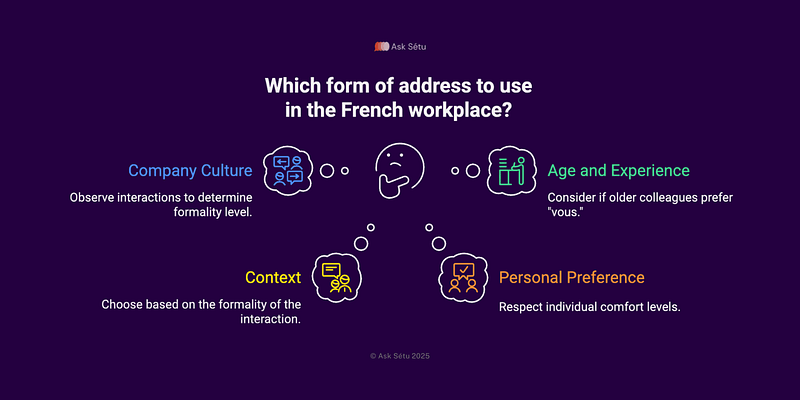
The key is adaptability — reading the room, observing interactions, and adjusting your language accordingly.
Bottom Line for Newcomers
When in doubt, start formal, then relax. Vous is never wrong, and switching to tu is easy once invited — but going the other way can feel awkward or even disrespectful.
In today’s French workplace, pronoun choice is less about strict rules and more about cultural intelligence: knowing when formality reinforces professionalism and when informality builds connection. It’s about speaking the language — and the culture — of your workplace.
💡 Want to master French workplace etiquette and accelerate your career success in France? Join Ask Sétu — the AI-powered platform that helps Indian students and professionals improve cultural readiness, adapt to local norms, and thrive in the French job market.
🔗 Sign up today and turn cultural nuances into career advantages.

 Ask Sétu Blog
Leave a comment