

In 2025, the higher education landscape is shifting. Canada, the UK, and Australia — once the “default” destinations for Indian students — are tightening visa rules, imposing study caps, and raising financial barriers. Canada has capped international student permits and requires Provincial Attestation Letters, limiting opportunities. The UK banned most international students from bringing dependents as of January 2024. Australia introduced the stricter “Genuine Student” test in 2024, alongside higher financial requirements. These measures make it harder for Indian students to pursue affordable undergraduate degrees in traditional destinations.
With these hurdles, many students and families are asking: What’s the alternative? France is emerging as a welcoming, affordable, and high-quality alternative, especially at the undergraduate level.
1. Affordable Tuition Fees
One of France’s biggest advantages is cost. Public universities charge around €2,770–€2,900 per year for a Bachelor’s degree for non-EU students (set nationally). This is dramatically lower than average tuition fees in Canada (~CAD 29,000/year), the UK (~GBP 22,000/year), or Australia (~AUD 32,000/year).
What’s more, many French universities and regional authorities have the discretion to waive or reduce fees for international students. For example, institutions like Sciences Po and certain universities in Lyon and Strasbourg have extended need-based tuition relief to foreign students, including Indians.
2. Programs in English
A common misconception is that you need to be fluent in French before starting studies. In reality, France offers over 1,600 programs taught fully or partly in English, including Bachelor’s degrees in fields like Business, Computer Science, Design, and Political Science. Business schools like offer globally recognized Bachelor programs with strong industry links, taught in English, and with integrated internships. On the creative side, schools like École de Design Nantes Atlantique attract undergraduates from around the world with bilingual design programs and pathways into global companies.
This gives students the freedom to begin their undergraduate journey without linguistic barriers, while simultaneously learning French at their own pace. You can study in English while taking French as a Foreign Language (FLE) classes, ensuring that by graduation, you’re equipped with a valuable bilingual skill set.
Many universities now offer Classes internationales, a dedicated pathway that combines intensive French courses with cultural orientation and academic preparation. This program is particularly helpful for undergraduates arriving with little or no French, as it allows them to gradually transition into mainstream coursework while building confidence in everyday life.
3. Support That Eases Student Life
Living abroad can be daunting, but France provides robust support for international students:
- 🏠 Housing Aid (CAF): Most students in France qualify for a monthly housing allowance from the government, typically between €100 and €280 depending on rent and city. This can significantly lower living costs, especially in expensive cities like Paris.
- 🚆 Discounted Transport: Regional student passes make commuting affordable — in Paris, the “Imagine R” pass gives unlimited travel for under €40/month.
- 🎟️ Cultural Discounts: Museums, theaters, and cinemas often offer €5–10 tickets for students, encouraging cultural immersion at low cost.
Together, these benefits make France not only academically attractive but also financially sustainable for Indian families.
4. Scholarships for Indian Undergraduates
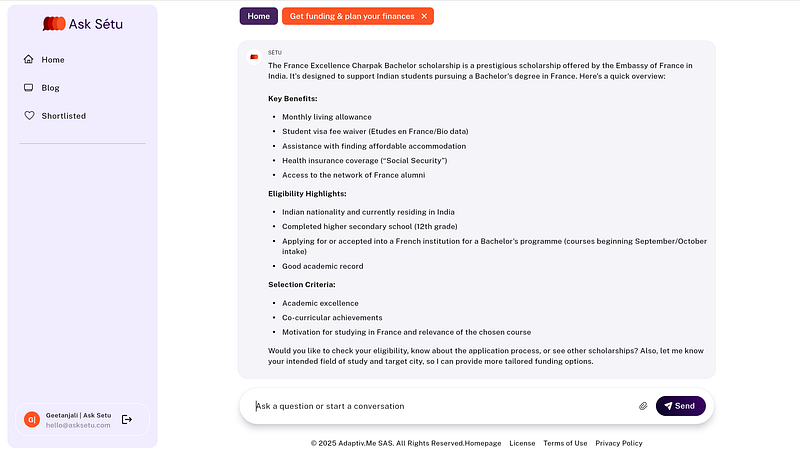
France has developed scholarships specifically for Indian students. The most prominent is the France Excellence Charpak — Bachelor Scholarship, which provides a monthly living allowance of 860 euros, covers student visa fee waivers and provides other financial aid & benefits.
In addition, individual institutions offer merit-based scholarships for outstanding applicants. Combined with low tuition, these scholarships make France one of the most cost-effective options among top study destinations.
5. Career Pathways After Graduation
France balances affordability with academic excellence and employability. Graduates can apply for the “Recherche d’emploi/Création d’entreprise” residence permit, which allows them to stay and seek jobs or start a business. While policy varies depending on the degree, France’s commitment to building strong India–France academic ties (with a goal of 30,000 Indian students by 2030) suggests more favorable post-study routes will continue to open.
At a moment when traditional study destinations are raising barriers, France is lowering them. For Indian students, the mix of affordability, scholarships, English-taught programs, and future career pathways makes France a powerful undergraduate choice.
The Eiffel Tower may symbolise the dream, but it’s the student-friendly policies and affordability that make France a reality.
💡 Want to explore undergraduate studies in France with confidence? Join Ask Sétu — the AI-powered platform that guides Indian students through applications, scholarships, and cultural readiness so you can study smarter, adapt faster, and thrive in France.

 Ask Sétu Blog
Leave a comment