

French opens doors to diverse professional opportunities in France, and elsewhere in the world. However, navigating the job market requires fluency beyond basic greetings. For any international professional seeking to establish themselves in France, mastering French is not just an advantage, it’s a necessity. Without a strong foundation in the language, effectively communicating with colleagues, understanding work instructions, and expressing your ideas confidently become significant hurdles.
How well should you speak French to work in France?
The CEFR framework lays out French proficiency in six levels: A1 (beginner), A2 (elementary), B1 (intermediate), B2 (upper intermediate), C1 (advanced), and C2 (mastery). While most people think that an A2 level on the Common European Framework of Reference for Languages (CEFR) is enough to work with a French company, it is not sufficient for working proficiency.
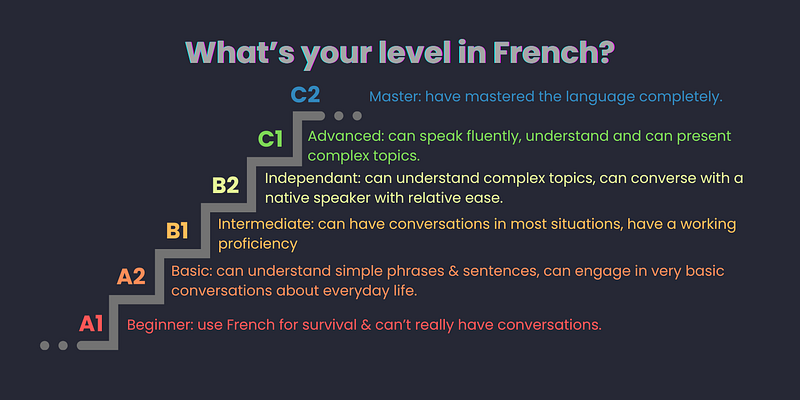
Why should you not be satisfied with an A2 to work in France?
At the A2 level, individuals can understand and use familiar everyday expressions in routine situations. They can introduce themselves and others, ask and answer simple personal questions, and engage in short, simple conversations. While this level allows for basic communication in daily life, it falls short in several aspects crucial for the workplace:
Limited vocabulary:
A2 French restricts your vocabulary to basic terms and expressions. This hinders effective communication in professional settings, where technical jargon, industry-specific terminology, and nuanced vocabulary are often necessary.
Difficulty understanding complex instructions:
Following intricate instructions, understanding company policies, or participating in technical discussions becomes challenging with limited language proficiency. This can pose a significant obstacle to performing work duties effectively and integrating seamlessly into the team environment.
Limited ability to express oneself:
An A2 level might limit your ability to articulate complex ideas, participate in discussions confidently, or present professional arguments, all essential skills for expressing yourself effectively at work.
Misunderstandings and misinterpretations:
With limited language skills, the risk of misunderstandings and misinterpretations increases, potentially impacting work quality and team dynamics.
What extra skills do you acquire at B1?
While A2 French provides a foundation, the minimum recommended level for working proficiency in France is B1. Individuals at this level can:
- Understand the main points of clear standard input on familiar matters regularly encountered in work, school, leisure, etc.
- Deal with most situations likely to arise while traveling in an area where the language is spoken.
- Produce simple connected text on topics which are familiar or of personal interest.
- Describe experiences and events, dreams, hopes, and ambitions, and briefly give reasons for opinions and plans.
At the B1 level, you can understand work-related instructions, emails, reports, and presentations, and participate effectively in meetings, negotiate, and express ideas clearly. Most importantly, you can build rapport with colleagues, demonstrate confidence, and integrate into the work environment.
Sometimes even someone with a B1 level of French might get rejected for a job in France, even though it’s considered the minimum for working proficiency.
Competition and Employer Preferences:
The French job market can be competitive, especially in certain sectors. Even with B1 French, you might be facing applicants with stronger fluency (B2 or higher) who can express themselves more confidently and handle complex topics. Some employers might prioritize candidates with local experience and familiarity with French business culture.
Industry-Specific Language:
B1 French provides a good foundation for general work communication. However, some industries might have specific technical jargon or complex concepts that require a higher language level (B2 or C1) to fully grasp and discuss effectively.
Focus on Spoken Communication:
B1 tests often focus on understanding spoken French and basic conversation. However, the workplace might involve tasks like reading technical reports, writing emails, or giving presentations. If these skills haven’t been practiced extensively, an applicant might struggle during the interview or job trial.
Cultural Nuances:
B1 French equips you to understand basic workplace interactions, but navigating subtle cultural cues or humor might still be challenging. This could impact your ability to connect with colleagues and demonstrate a well-rounded understanding of the work environment.
Tips to increase your chances of success with B1 French:
- Highlight Your Skills: Focus on the specific strengths you bring to the table, even with B1 French. This could be industry-specific knowledge, strong technical skills, or a proven track record in your field.
- Prepare for Industry-Specific Terms: Research the specific industry and try to learn relevant technical terms in French beforehand. This can be particularly useful in impressing the recruiters and convincing them of your ability to communicate in French.
- Demonstrate Initiative: Express your eagerness to learn French and improve your language skills. Take online courses, attend language exchange events, or showcase your efforts to adapt to the French work culture. Highlight your commitment to improving your French by mentioning ongoing language learning efforts.
- Target Your Applications: Strategically apply for jobs where B1 French might be sufficient, perhaps in companies with a strong international presence or roles with less emphasis on complex communication.
- Practice Interviewing in French: Simulate interview scenarios with a native speaker to build confidence and fluency in expressing yourself professionally.
While B1 is a good foundation, consider these factors to bridge the gap and unlock French job opportunities. Aim for a higher level, and highlight your strengths to confidently navigate the French workplace.


 Ask Sétu Blog
Leave a comment