
France hosts one of the most structured—and at times misunderstood—higher-education systems in the world. With over 2.9 million students, including more than 400,000 international students, the country has built a dual academic model that blends accessibility, academic rigour, and global prestige.
For students considering France, understanding the distinction between Universities, Grandes Écoles, and other specialised institutions is crucial. Each pathway serves a different academic profile, career ambition, and learning style.
Choosing the right type of institution in France is often more important than choosing the city.
This article breaks down how the French system works, how degrees are structured, and how to determine which path is right for you.
A System Built on Structure and Recognition
France follows the LMD framework – Licence, Master, Doctorat – which aligns with the broader European Bologna Process, ensuring academic recognition across Europe and beyond.
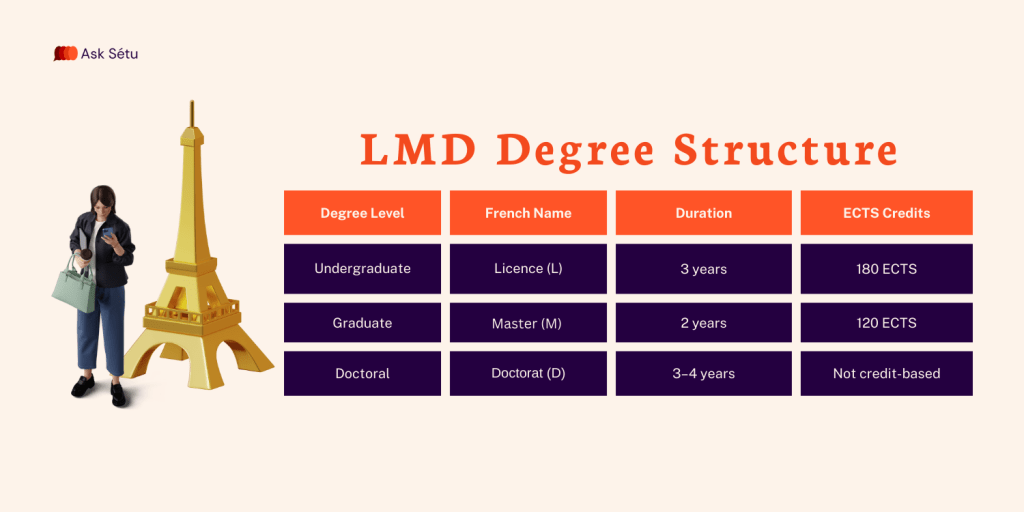
This standardised framework makes France especially attractive to international students seeking mobility, academic credibility, and career flexibility.
Universities: Accessibility at Scale
French public universities are state-funded institutions designed to provide broad access to higher education. They enrol nearly two-thirds of all students in France.
Key characteristics:
- Open admissions (subject to degree equivalence)
- Strong emphasis on theory and research
- Wide range of disciplines
Who Are Universities Best For?
Universities are ideal for students who:
- Prefer academic independence
- Are interested in research or doctoral studies
- Want access to affordable tuition
- Value disciplinary breadth
Annual tuition at public universities remains accessible at €2,850 (Licence) and €3,879 (Master) per year for international students.
Grandes Écoles: Selectivity, Prestige, and Professional Power
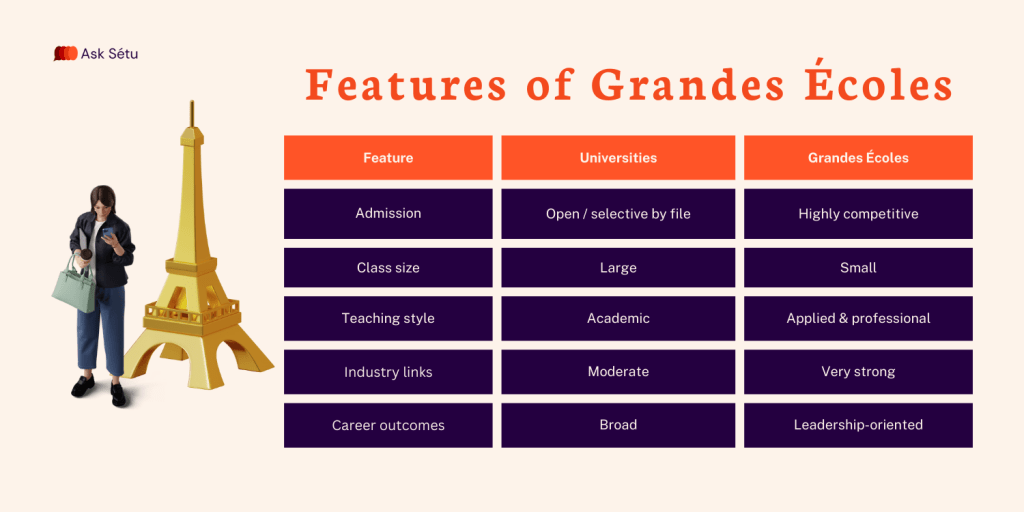
Grandes Écoles are elite institutions operating parallel to the university system. Admission is highly competitive, class sizes are small, and outcomes are closely tied to leadership and industry roles.
They specialise in:
- Engineering
- Business and management
- Public administration
- Political science
“In France, elite education is defined less by universities and more by Grandes Écoles.” — The Economist
Graduates of Grandes Écoles dominate executive roles in French and European companies. For example, over 70% of CEOs of CAC 40 companies are alumni of Grandes Écoles.
Preparatory Classes (CPGE): The Elite Gateway
Many students enter Grandes Écoles through Classes Préparatoires aux Grandes Écoles (CPGE) – intensive two-year programs focused on mathematics, science, humanities, or commerce.
CPGE programs are academically demanding and culturally intense, but exceptionally rewarding for students aiming at top-tier institutions.
These programs are typically taught in high schools, not universities, and require strong academic stamina.
Specialized and Professional Institutions
Beyond universities and Grandes Écoles, France offers a rich ecosystem of specialized schools, including:
- Art and design schools
- Architecture schools
- Culinary and hospitality institutes
- Paramedical and social-work schools
Many award state-recognised diplomas and maintain strong professional integration.
“France’s strength lies not only in elite institutions, but in the diversity of its specialised training pathways.” — Campus France
Teaching Philosophy: Independence Over Instruction
A defining feature of French higher education is its emphasis on student autonomy.
- Fewer continuous assessments
- Heavier final examinations
- Strong expectation of self-directed learning
For international students accustomed to constant coursework, this shift can be challenging—but transformative.
In France, higher education trains thinkers before training specialists.
How to Choose the Right Path
When deciding between universities, Grandes Écoles, and specialised institutions, take some time to reflect on the following points:
- Career ambition: Academic, corporate, entrepreneurial?
- Learning style: Independent vs structured?
- Selectivity tolerance: Open admission or competitive exams?
- Budget: Public tuition vs private investment?
- Long-term mobility: Research, industry, or leadership?
The French higher-education system is well-designed network of pathways, each designed to serve a distinct academic and professional objective. Understanding the system is the first step to mastering it.
Whether you choose the accessibility of a university, the prestige of a Grande École, or the precision of a specialised school, France offers something few countries can: globally recognised degrees, public investment in education, and a deep connection between academia and society.
Planning to study in France?
Ask Sétu is here to guide you through admissions, scholarships, and life in France. Explore your options with AI-powered tools, expert tips, and real student stories…so you can focus on building your future.

 Ask Sétu Blog
Leave a comment