

If you’ve recently arrived in France (or are planning to) you may already have sensed something unusual about how the French deal with money. It’s not that money doesn’t matter here. On the contrary, it matters a great deal. But it is handled indirectly, cautiously, and wrapped in layers of cultural codes.
As a French teacher working closely with international students, I often describe it this way: in France, money is discussed constantly, but almost never personally.
Let’s start with a moment many expats experience:
You’re at a dinner, someone casually asks, “So how much did this apartment cost?”
Silence.
Forks pause mid-air.
The question isn’t rude by intention, but in France, it can be perceived as deeply intrusive. Asking about someone’s salary or purchase price is considered private to the point of taboo.
Yet here’s the paradox: the same people will happily spend half an hour complaining about supermarket prices, fuel costs, rent increases, or taxes. Criticising prices is not only acceptable, it’s a national bonding activity. What’s avoided is revealing your own financial position.
Why the French Are Like This With Money
This attitude comes from several intertwined cultural layers.
First, there is the Republican ideal of equality. Publicly displaying wealth, or even openly discussing income, is considered a breach of an unspoken social contract. Flaunting money is often perceived as vulgar or individualistic.
Second, there’s historical and religious influence. Catholic and Protestant traditions have both framed wealth with moral suspicion. Earning money is fine; talking about it is less so.
Finally, there’s pragmatism. France has a highly progressive tax system. Discussing salary often reveals your tax bracket, and no one wants to advertise that they’re “paying for half the country.”
The result? A sophisticated code language around money.
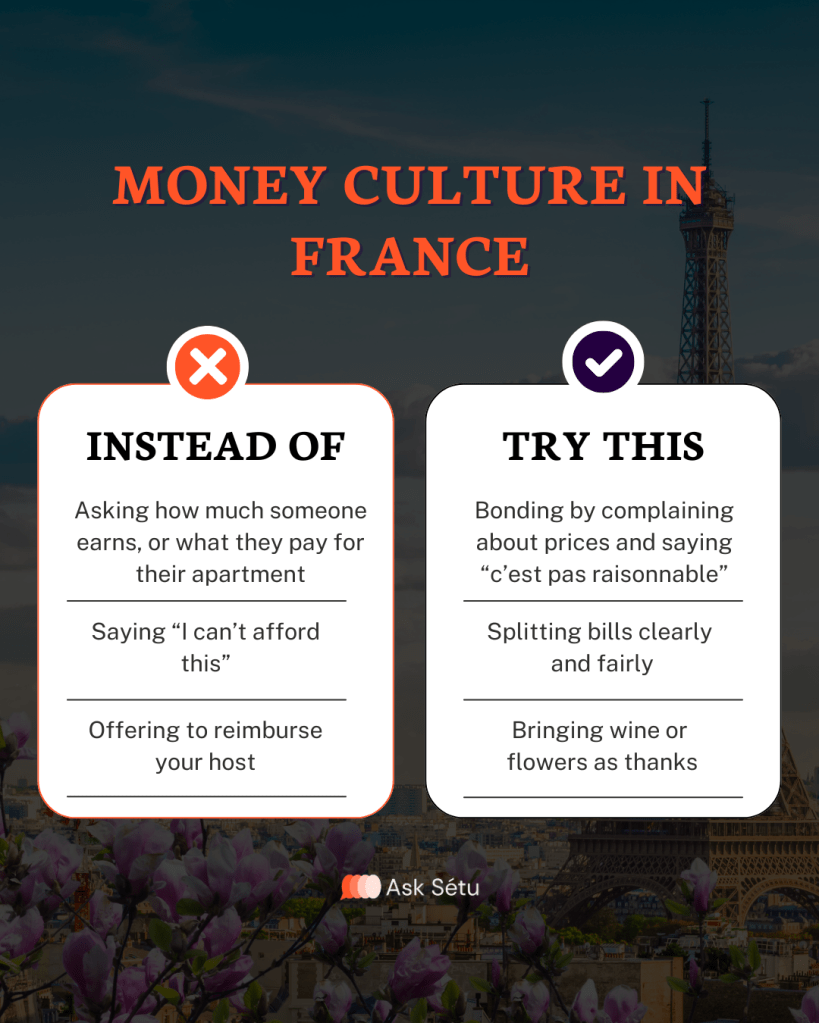
If someone says a neighbourhood is sympa, it often means affordable. If they say it’s très recherché, it means expensive, but they want you to know they belong there. Instead of “I can’t afford it,” you’ll hear “Ce n’est pas raisonnable” or “C’est abusé.” The issue is never the person’s budget. It’s the outrageous price.
Money at Work: Silence, Not Transparency
For international students entering internships or jobs, this part can be particularly jarring.
In many cultures, colleagues openly discuss salaries to ensure fairness. In France, salary information is treated like classified material. It’s not uncommon for people doing identical roles to discover pay differences years later, and even then, raising the topic can feel transgressive.
This doesn’t mean exploitation is accepted; it means hierarchy and discretion dominate workplace norms. Negotiation happens behind closed doors, not at lunch tables.
Splitting Bills: Precision Over Generosity
Nowhere is French money culture more visible than when splitting a bill.
Expect forensic-level accounting. Who had dessert? Who drank wine? Who didn’t? Apps like Tricount are used religiously, not because people are stingy, but because fairness matters deeply. No one should pay for what they didn’t consume.
What many newcomers misinterpret as cheapness is actually discomfort with social debt. If someone pays for you, an obligation is created, and that unease lingers until balance is restored.
This explains why casual “I’ll get this one, you get the next” generosity doesn’t always land smoothly. French culture prefers clean accounts.
The Beautiful Contradiction
Here’s what surprises most students eventually.
Despite this strictness with money, the French are extraordinarily generous with time, effort, and hospitality. A friend may cook you a five-course meal and refuse any contribution. They’ll help you move apartments for an entire day without expecting compensation.
Money is private. Friendship is not.
Once you’re “in,” generosity flows, but it doesn’t take the form of casual spending. It takes the form of presence, help, and commitment.
Your Survival Guide as a Student in France
- Don’t ask what someone earns or paid for their apartment
- Do complain about prices. iRemember, it’s social glue
- When paying, either split precisely, or pay discreetly
- Never suggest reimbursing a French host, bring wine or flowers instead
Understanding these nuances won’t just save you from awkward moments. It will help you decode French social logic, navigate workplaces, and build relationships that last.
At Ask Sétu, this is exactly the kind of invisible knowledge we help Indian students acquire, because success in France isn’t just about degrees or visas. It’s about cultural fluency.

 Ask Sétu Blog
Leave a comment