
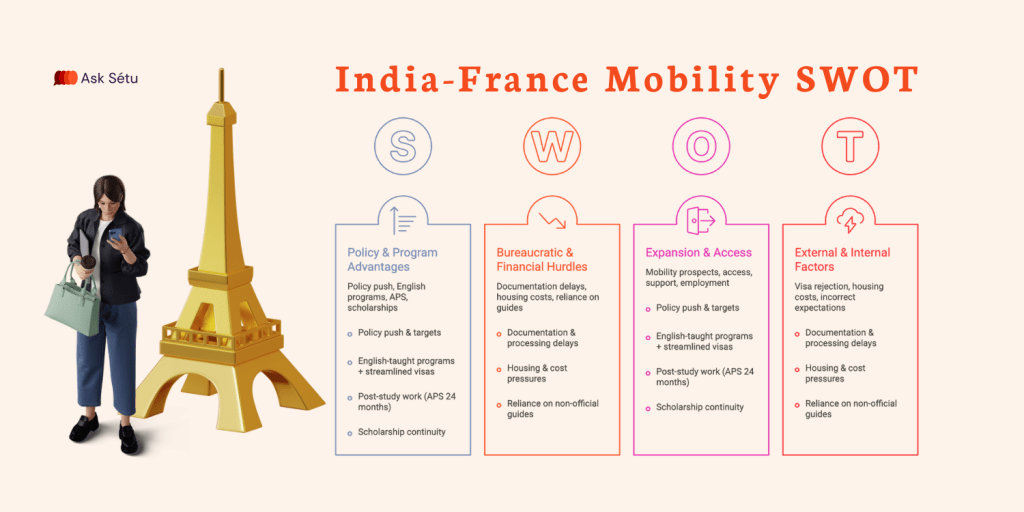
When evaluating overseas education pathways, students often focus on rankings and return on investment. But a more strategic lens with a SWOT analysis reveals a deeper picture. For Indian students considering France, the landscape today presents a compelling mix of policy-driven opportunity and operational risk. Understanding both sides is critical to making informed decisions.
Below, we apply a SWOT framework to India–France mobility to help students and families assess where the real advantages lie, and where caution is warranted.
The Opportunity Landscape: Structural Tailwinds for Indian Students
1. Policy Push & Bilateral Targets: A Strategic Partnership in Motion
India and France have significantly strengthened educational cooperation in recent years. France has publicly set an ambitious target of welcoming 30,000 Indian students annually by 2030, a substantial increase from current levels (which have grown steadily in the last five years).
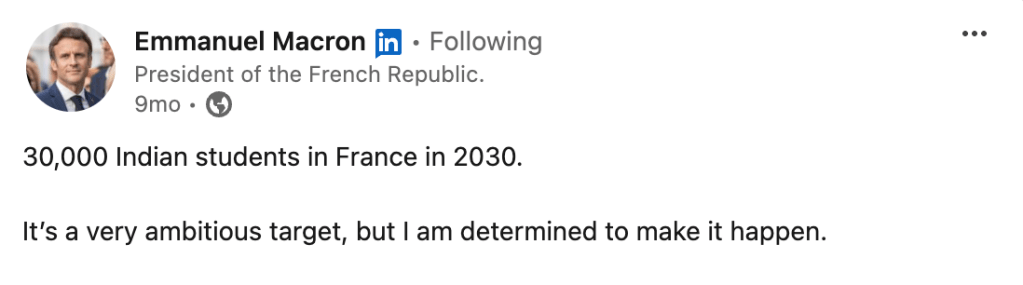
This policy push translates into:
- Expanded institutional partnerships
- Dual-degree programs
- Joint research initiatives
- Enhanced outreach by Campus France
Such structured cooperation strengthens institutional linkages, improves visibility for Indian applicants, and increases administrative support across application pipelines. For students, this means they are no longer navigating the system in isolation. The policy environment is aligned in their favour.
2. English-Taught Programs + Streamlined Visas: Lowering Entry Barriers
Historically, language was perceived as a barrier. Today, France offers over 1,600 programs taught in English, particularly in business, engineering, data science, luxury management, sustainability, and international relations.
For Indian students without French proficiency:
- English-taught master’s programs reduce linguistic entry friction.
- Visa processes have become more structured via France-Visas and Campus France platforms.
- Digitised appointment systems and clearer document checklists reduce ambiguity when followed properly.
These structural improvements lower access barriers, making France competitive with other European destinations such as Germany or the Netherlands.
3. APS (Autorisation Provisoire de Séjour): 24 Months to Build a Career
A standout feature in France’s student mobility ecosystem is the 24-month post-study work authorization (APS) available to eligible master’s graduates.
Compared to many European destinations that offer 12–18 months, this two-year window significantly enhances employability prospects by allowing graduates to:
- Seek full-time employment aligned with French salary thresholds
- Transition to a work permit upon securing qualifying employment
- Explore entrepreneurial pathways, including startup incubation programs
France’s innovation ecosystem, especially in AI, sustainability, luxury, aerospace, and mobility, offers viable pathways for skilled graduates. Paris, Toulouse, Lyon, and Grenoble are recognised hubs in their respective sectors.
The APS effectively transforms a degree into a structured pathway toward career consolidation.
4. Scholarship Continuity: Structured Financial Mitigation
Cost is a primary concern for Indian families. France offers several established scholarship programs that help offset tuition and living expenses:
- Eiffel Excellence Scholarship (French Ministry for Europe and Foreign Affairs)
- Charpak Scholarship (for Indian students)
- Erasmus+ mobility grants
Public university tuition in France remains comparatively moderate relative to the UK, US, or Australia. When combined with scholarships and the ability to work part-time (up to 964 hours annually), the financial model becomes significantly more viable.
However, eligibility criteria are competitive, and timelines must be carefully managed.

The Risk Dimension: Operational Frictions That Still Matter
Opportunity does not eliminate execution risk. In fact, the most common challenges faced by Indian applicants stem from process gaps rather than policy limitations.
1. Documentation & Processing Delays: A Persistent Rejection Driver
Visa refusals frequently trace back to:
- Incomplete financial documentation
- Incorrect bank statement formats
- Inconsistent academic records
- Misaligned statement of purpose narratives
- Improperly translated documents
Despite digitisation, documentation precision remains non-negotiable. Even minor discrepancies can lead to delays or rejection. Processing timelines can also stretch during peak intake seasons (May–August), increasing stress for late applicants.
The lesson: France is administratively structured, but unforgiving of procedural errors.
2. Housing & Cost Pressures: Urban Realities
While tuition may be moderate, housing remains a constraint, especially in Paris, Lyon, and Nice.
Key considerations:
- CROUS student housing availability is limited.
- Private rentals often require guarantors.
- Security deposits and upfront payments can be substantial.
- Monthly living costs in Paris may range between €1,200–€1,500 depending on lifestyle.
Students who delay accommodation planning often face inflated prices or suboptimal housing. Financial planning must therefore extend beyond tuition alone.
3. Reliance on Non-Official Guides: The Misinformation Risk
A growing challenge in India–France mobility is dependence on:
- Unverified WhatsApp groups
- Outdated blog posts
- Informal “consultant templates”
- Peer anecdotal advice
Policies evolve, financial thresholds change, and visa documentation rules are periodically updated. Failure to cross-check information against Campus France and France-Visas official portals can create unrealistic expectations or critical documentation errors.
In mobility ecosystems, information asymmetry is often the hidden risk.
France is a high potential destination for Indian students pursuing higher education opportunities outside the country, but only if executed correctly.
Opportunity without clarity can quickly turn into risk. That’s where Ask Sétu becomes a strategic ally. Instead of navigating fragmented information across multiple sources, students get structured, verified guidance grounded in current policy frameworks.
If you’re considering France, or are already mid-process and unsure about documentation, APS eligibility, scholarships, or housing strategy – don’t leave critical decisions to guesswork.

 Ask Sétu Blog
Leave a comment