

Moving to France for your studies is exciting—but one of the first and most important challenges you’ll face is finding a place to live. The French housing system can feel confusing at first, especially if you’re navigating it from another country.
Understanding the types of accommodation available, how applications work, and what landlords expect can make your transition much smoother. If you start early and prepare the right documents, securing student housing in France becomes much more manageable.
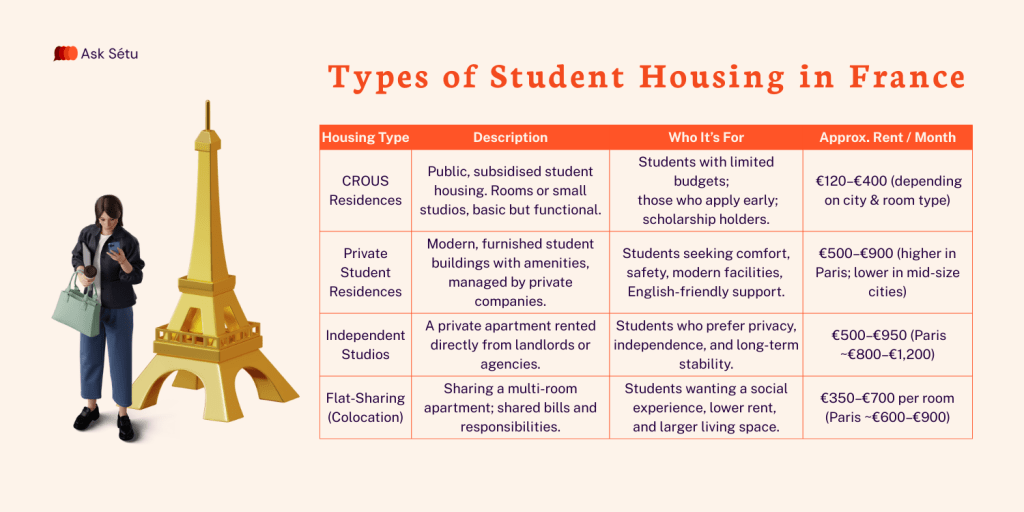
France offers several types of accommodation suitable for students, each with different price ranges, amenities, and levels of privacy.
1. CROUS Residences (Public Student Housing)
CROUS housing is government-subsidised student accommodation and is often the most affordable option available. Typically located close to university campuses, CROUS residences provide basic rooms or small studios designed specifically for students. Monthly rent usually ranges between €120 and €400 depending on the city and room type.
Advantages:
- Very affordable
- Located near campuses
- Managed by public student services
Challenges:
- Extremely competitive
- Limited availability
- Shared facilities in some buildings
International students interested in CROUS housing should apply early through the official CROUS housing portal. Even if you apply, it’s wise to keep backup housing options because spaces fill quickly.
2. Private Student Residences
Private student residences are modern, purpose-built housing complexes designed for students and managed by private companies.
These accommodations typically offer furnished rooms or studios along with shared facilities such as study rooms, laundry services, and community spaces. Student Renting in France (1)
Monthly rent usually ranges between €500 and €900, though prices in Paris may be higher.
Advantages:
- Furnished apartments
- Safer and professionally managed
- Amenities like reception, study rooms, and maintenance support
Challenges:
- Higher cost compared to public housing
Students can search for these residences through platforms like Studapart, Uniplaces, or ImmoJeune. When applying, you’ll usually need a rental dossier that includes documents such as proof of admission, student ID, and guarantor details.
3. Independent Studios
Some students choose to rent a private studio apartment directly from landlords or agencies.
This option provides full privacy and independence but is often more expensive, especially in large cities. Monthly rent typically ranges from €500 to €950, with Paris studios often exceeding €800–€1,200. Student Renting in France (1)
Advantages:
- Complete privacy
- More control over your space
- Suitable for longer stays
Challenges:
- Higher rent and additional utility costs
- Landlords often require a guarantor
Students searching for studios often use platforms such as LeBonCoin, Seloger, or Studapart. Before sending any payment, always request a virtual tour or verify the listing to avoid scams.
4. Flat-Sharing (Colocation)
Flat-sharing, known as colocation in France, is a popular option among students who want affordable rent and a social living environment.
In this arrangement, several tenants share an apartment while splitting rent and utility bills. Rent typically ranges from €350 to €700 per room, though Paris can be higher. Student Renting in France (1)
Advantages:
- Lower rent
- Social living environment
- Larger apartments than individual studios
Challenges:
- Less privacy
- Need to coordinate with roommates
Platforms like La Carte des Colocs, Appartager, and Facebook housing groups are commonly used to find shared apartments. Before moving in, it’s important to discuss shared responsibilities such as utilities, internet bills, deposits, and renters’ insurance.
Understanding the “Guarantor” Requirement
One unique feature of renting in France is the requirement for a garant (guarantor).
A guarantor is a person or organisation that promises to cover the rent if the tenant cannot pay. Many landlords require this before signing a lease.
For international students without a French guarantor, services such as Visale (free) or GarantMe (paid) can provide financial guarantees accepted by many landlords. Student Renting in France (1)
Preparing for Your Move
Finding accommodation is much easier when you prepare early and organise the necessary documents.
Before arriving in France, students should:
- Submit CROUS applications early
- Prepare a digital rental dossier
- Arrange a guarantor if needed
- Research housing platforms
- Estimate their monthly housing budget
- Schedule virtual or in-person apartment visits
- Plan lease signing and home insurance
Taking these steps in advance helps avoid last-minute stress and gives you more housing choices.
Finding accommodation as an international student in France can feel overwhelming at first, but with the right information and preparation, it becomes much easier.
Start your housing search early, explore multiple options, and always verify listings before committing to a lease. Whether you choose public housing, a private residence, a studio, or a shared apartment, planning ahead will ensure that your new life in France begins smoothly.


 Ask Sétu Blog
Leave a reply to Key Steps while Preparing for Higher Education in France – Ask Sétu Blog Cancel reply